
If you are reading this, odds are you are shifting in your chair right now, trying to find that one position where your lower back doesn’t throb. You are not alone. In the United States, lower back pain is the single leading cause of disability, and for the millions of Americans working the 9-to-5 grind, the office chair is often the primary culprit.
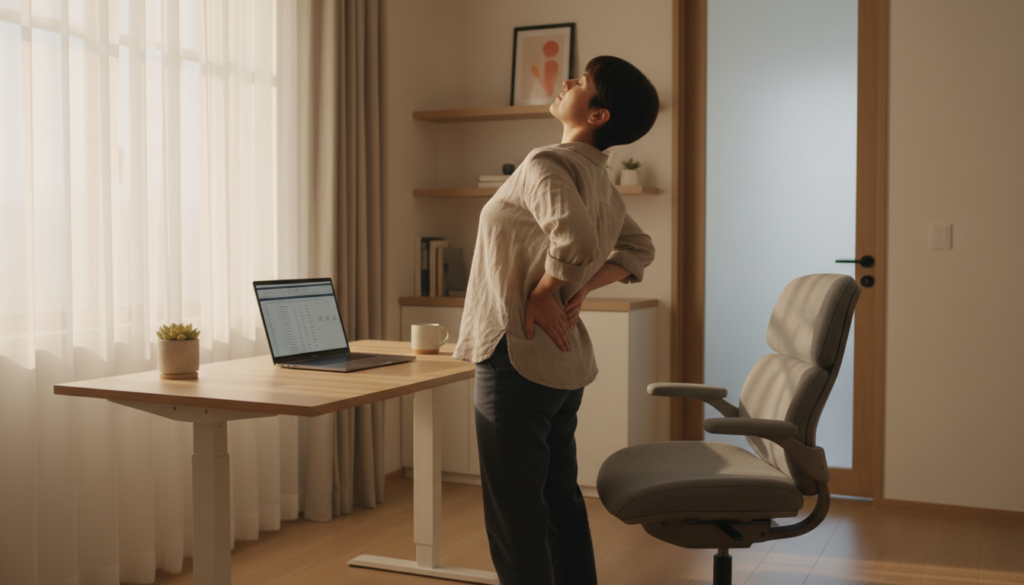
We call it the “Office Worker’s Slump.” It starts with a dull ache around 2:00 PM, evolves into morning stiffness, and eventually becomes a chronic issue that prevents you from enjoying your weekends. But here is the good news: your back is not broken, it is just deconditioned and compressed.
This article outlines a comprehensive lower back pain relief program for office workers. We aren’t just talking about buying a fancy lumbar pillow (though that helps); we are talking about a holistic approach combining ergonomics, mobility, and strength training designed specifically for the corporate athlete.
Understanding the Enemy: Why Sitting Destroys Your Back
Before diving into the solution, we need to understand the problem. The human body evolved to move—to hunt, gather, run, and squat. It did not evolve to sit at a 90-degree angle for eight to ten hours a day staring at a Zoom meeting.
The Biomechanics of the Seated Position
When you sit, particularly with poor posture, several things happen:
- Hip Flexor Tightness: Being in a seated position shortens your hip flexors (the muscles at the front of your hip). When you finally stand up, these tight muscles pull your pelvis forward, creating an anterior pelvic tilt that compresses the lumbar spine.
- Gluteal Amnesia: Sitting on your glutes all day causes them to become inactive and weak. Your glutes are the primary stabilizers of your lower back. When they stop working, your lower back muscles have to work overtime to keep you upright.
- Disc Compression: Slumping puts immense pressure on the intervertebral discs. Over time, this can lead to bulging or herniated discs, pressing on nerves and causing sciatica.
Phase 1: The Ergonomic Audit
You cannot heal your back if you spend 40 hours a week injuring it. The first step in our relief program is an immediate audit of your workspace. Whether you are in a cubicle in Manhattan or a home office in Austin, the rules of ergonomics remain the same.
1. The Chair Setup
Your chair is your primary tool. If you are going to invest in one thing, make it a high-quality ergonomic chair.
- Seat Height: Your feet should be flat on the floor with your knees at a 90-degree angle. If your feet dangle, you need a footrest immediately.
- Lumbar Support: Your chair should mimic the natural curve of your spine. If there is a gap between your lower back and the chair, fill it with a dedicated lumbar roll.
- Recline: Avoid sitting bolt upright at 90 degrees strictly. A slight recline (about 100-110 degrees) can actually reduce disc pressure.
2. Monitor and Desk Geometry
Looking down at a laptop screen is a disaster for your kinematic chain.
- Eye Level: The top third of your monitor should be at eye level. This prevents your head from jutting forward (tech neck), which pulls on the entire posterior chain down to the lower back.
- Keyboard Position: Your elbows should be bent at 90 degrees and close to your body. Reaching forward for the mouse adds unnecessary torque to the back muscles.
3. The Standing Desk Revolution
If your budget allows, a sit-stand desk is a game-changer. However, the key is alternating. Standing still for 4 hours is just as bad as sitting. Aim for a ratio of 45 minutes sitting to 15 minutes standing.
Phase 2: The “Desk-Bound” Mobility Routine
You don’t need a gym to start fixing your back. You can integrate “movement snacks” directly into your workday. Set a timer on your phone for every hour. When it goes off, perform this 3-minute circuit.
The Seated Figure-Four (Piriformis Stretch)
This targets the deep hip rotators which often compress the sciatic nerve.
- Sit on the edge of your chair.
- Cross your right ankle over your left knee.
- Keep your spine straight and gently lean forward from the hips until you feel a deep stretch in the right glute.
- Hold for 30 seconds, then switch sides.
The Seated Thoracic Rotation
Stiffness in the upper back (thoracic spine) forces the lower back to twist more than it should.
- Sit tall with feet flat.
- Place your right hand on the outside of your left knee.
- Gently twist your torso to the left, looking over your left shoulder.
- Hold for 20 seconds. Repeat on the other side.
The Desk Hip Flexor Stretch
- Stand up and face away from your desk.
- Place the top of your right foot on the chair behind you.
- Squeeze your right glute and stand tall. You should feel a stretch in the front of the right hip.
- Hold for 45 seconds per side.
Phase 3: The After-Hours Strengthening Protocol
Stretching provides temporary relief, but strengthening provides a permanent cure. To bulletproof your back, you need to strengthen the “anti-sitting” muscles: the core and the glutes. Perform this routine 3 times a week.
1. The McGill Big 3
Dr. Stuart McGill, a world-renowned spine expert, recommends these three non-negotiable exercises for back stability.
A. The Curl-Up (Not a Crunch)
- Lie on your back, one leg straight, one bent.
- Place hands under your lower back to maintain a neutral arch.
- Lift your head and shoulders just an inch off the ground without bending your lower back.
- Hold for 10 seconds. Repeat 6 times.
B. The Side Plank
- Lie on your side, supported by your elbow.
- Lift your hips so your body forms a straight line.
- Hold for as long as possible with good form (aim for 30-45 seconds).
- Targets the Quadratus Lumborum (QL), a major source of back pain.
C. The Bird-Dog
- Start on hands and knees (tabletop position).
- Extend your opposite arm and opposite leg simultaneously until they are straight.
- Focus on not letting your hips rock side to side.
- Hold for 10 seconds, then switch. Do 10 reps per side.
2. Glute Bridges
Since sitting deactivates glutes, we must wake them up.
- Lie on your back with knees bent.
- Drive through your heels to lift your hips toward the ceiling.
- Squeeze your glutes hard at the top for 2 seconds.
- Lower slowly. Perform 3 sets of 15 reps.
Phase 4: Lifestyle Factors & Hydration
Hydrate Your Discs
Your spinal discs are largely made of water. During the day, gravity compresses them, squeezing fluid out. At night, they rehydrate. If you are chronically dehydrated—common among office workers fueled by coffee—your discs remain brittle and prone to injury. Aim for at least 80-100 oz of water daily.
The Commute Factor
Driving is essentially “stressed sitting.” If you have a long commute, adjust your car seat similarly to your office chair. Use a lumbar support pillow in the car if the seat is bucket-style, which often encourages slouching.
When to See a Professional
While this lower back pain relief program for office workers is effective for mechanical back pain, there are red flags that require medical intervention. If you experience numbness in the legs, loss of bladder control, or pain that wakes you up at night, schedule an appointment with a physical therapist or orthopedic specialist immediately.
Conclusion: Consistency is Key
The road to a pain-free back isn’t paved with magic pills or expensive gadgets. It is paved with consistency. You spent years conditioning your body to sit poorly; it will take a few weeks to recondition it to stand tall.
Start Phase 1 today. Adjust your monitor. Order that lumbar cushion. Set your hourly timer. By integrating these small changes into your workflow, you can banish the “Office Slump” and return to a life of pain-free movement.
Ready to take the next step? Don’t let back pain dictate your career or your happiness. Invest in your health today, because the only thing you should be breaking at work is records, not your spine.
lower back pain relief program for office workersget This Guide
best ergonomic chair for back painbuy lumbar support pillowstanding desk converter pricetop rated orthopedic seat cushionchiropractor for lower back pain near meback pain relief program downloadschedule physical therapy appointment
ergonomic office chair setupsciatica relief exercisesposterior chain strengtheningthoracic spine mobilityDr. Stuart McGill Big 3sit-stand desk benefitsanterior pelvic tilt correctionlumbar support for office chairphysical therapy for back painhip flexor stretches for sitting
lower back pain relief program for office workers
buy desk exercises for lower back pain
best seated stretches for lower back pain at work
how to fix lower back pain from sitting at desk
quick office chair back pain exercises
digital guide for office back pain relief
lumbar pain relief routine for programmers
desk stretches for back pain pdf
effective 5 minute back stretches for work
physical therapy desk exercises for lower back